
Delaware County Most Wanted
Delaware County Sheriff's official Most Wanted page is the place to start. It offers a search field plus listing cards for each person the Sheriff's office is seeking. The count of listings shifts over time. No fixed update schedule is published. So the live page beats any old copy or secondhand social media post.
Each card shows a name, a photograph, and a "Submit A Tip" link. The photos belong on the official page and are not rehosted anywhere else. Treat the list as a public-safety notice from the Sheriff's office, plain and simple. The wanted-list interface is a searchable Sheriff resource. It is maintained directly by the county, not a gallery run by a third party.
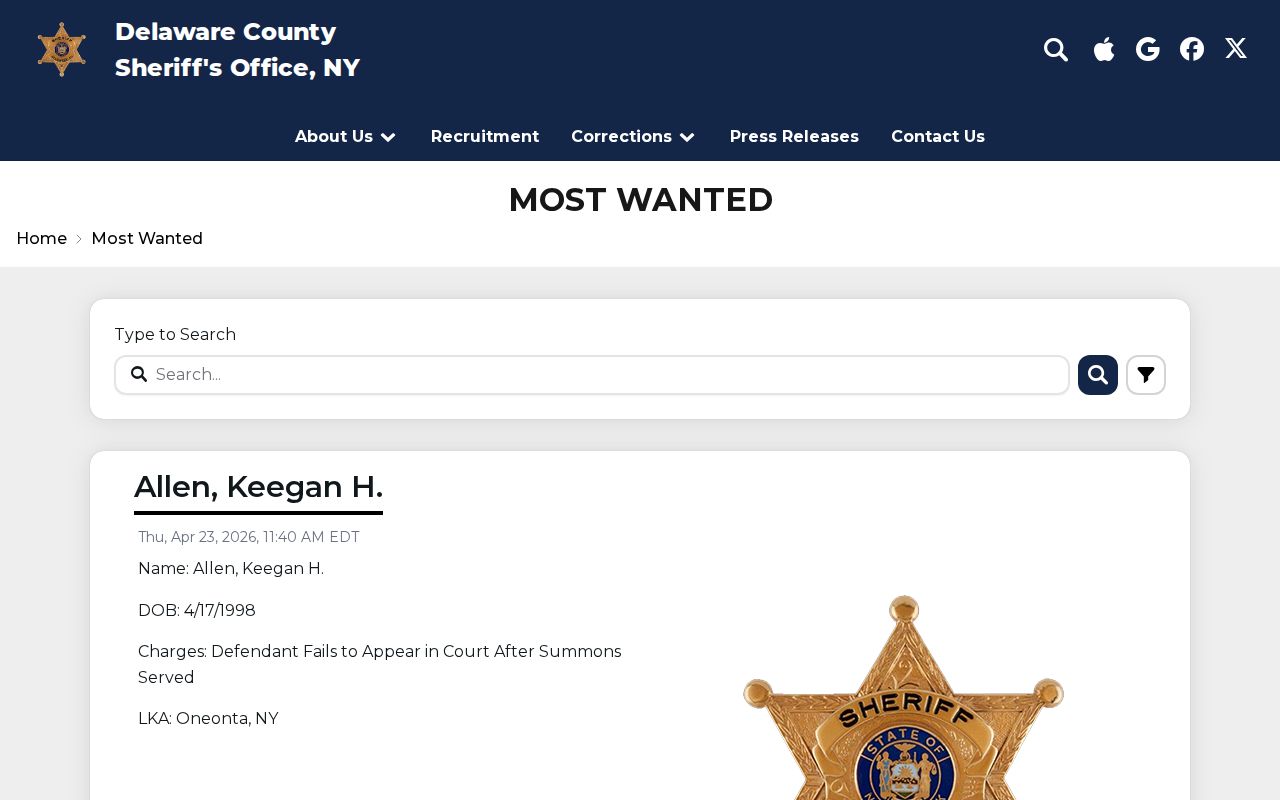
The screenshot exists to show the official interface and its tip path. Status can change between visits, so check the live Sheriff page before acting on any listing.
Delaware Wanted Listing Details
The Sheriff's cards display only certain fields. Age, last known address, charge details, or other specifics appear only if the office publishes them. Filling in gaps from a similar name, a reposted photo, or a third-party claim is a recipe for error. A missing field simply means the page keeps that detail out of public view. The Sheriff's office may hold far more behind the scenes than the card reveals.
| Visible item | What it means |
|---|---|
| Name | Identify the person shown by the official listing, subject to live changes. |
| Photograph | An image displayed on the Sheriff’s wanted page, not a custody booking record. |
| Submit A Tip | A link for information to law enforcement, not a way to confirm a warrant. |
| Search field | A way to locate a visible listing on the current page. |
| Update timing | No regular cadence was posted in the reviewed public interface. |
Wanted and custody are two different status labels. The county jail roster lists people currently held behind bars. A wanted listing covers people the Sheriff has identified or is actively seeking. The two lists can overlap. But they answer different questions. Neither one tells you where a case stands in court.
Read Delaware Most Wanted Safely
Think of the Most Wanted list as a bulletin board, not a to-do list. Seeing a name there does not deputize you. Never follow or confront anyone you recognize. Don't try to detain them either. Pass what you know through the official channel instead. In an emergency, dial 911 right away. Online forms move slower than a phone call when seconds matter.
- Open the live Sheriff Most Wanted page and search only for the name needed.
- Read the current card carefully and do not assume that an older image or post reflects the current listing.
- Use the card’s official Submit A Tip route to pass relevant information to the Sheriff.
- Do not approach or try to detain a listed person. Let trained law enforcement handle contact.
Delaware County Warrant Check
Delaware County, New York has no verified public portal for a warrant check. What exists online is a curated Most Wanted list. That list leaves out plenty. Someone can have an active warrant and never appear on the page at all. For a real answer on a specific warrant, contact the issuing court, the county clerk, or your attorney. The Sheriff's office also handles identity checks and records requests. Name searches done on your own carry real risks. Results can lag behind reality or match the wrong person entirely.
- Contact the Delaware County Sheriff’s Office NY at (607) 832-5555 and ask what process applies to a warrant-status question.
- Identify the handling court or clerk through New York e-Courts or the case paperwork.
- When the matter may concern you, seek legal advice from an attorney and follow the court’s direction rather than relying on a public listing.
- For a later arrest or county-custody question, use the official roster and records routes described on the county booking-record and roster page.
| Status question | Best official route |
|---|---|
| Visible wanted listing | Live Sheriff Most Wanted page. |
| Specific warrant status | Sheriff process, relevant court, clerk, or attorney. |
| Current county custody | Sheriff incarcerated-inmate roster. |
| Case outcome | Handling court and certificate of disposition. |
Tips for Delaware Wanted Cases
The Sheriff's official Submit A Tip page is the right place to send information about anyone listed. What you won't find is a documented Crime Stoppers chapter. There's no anonymity pledge or reward fund tied to Delaware County either. Rather than promise confidentiality or cash the Sheriff hasn't offered, note the gap. Whatever protections exist are whatever the agency itself has posted.
280 Phoebe Lane, Suite One
Delhi, NY 13753
(607) 832-5555
Use 911 for an emergency.
Share only what you can give safely and within the law. Leave the follow-up decisions to the agency. A tip is not a court filing, a status certificate, or a tool for winning a personal feud.
Delaware Warrant Record Limits
A wanted card is narrow by design. The Sheriff can add, remove, or edit entries at any time, with no posted schedule, and the office never promises the roster covers every open warrant. So a name that is missing proves nothing either way. And a matching name on a search result should not settle a person-specific question without confirmation from the agency or the court itself.
The Sheriff separates its public tools by function: current inmates, most wanted, news alerts, tips, facility details, and the app. Pick the page that fits the question. Custody questions go to the inmate roster. The Most Wanted page works as public notice. For later case status, the court and clerk are the right stop, and a narrow county records request covers older official records the other tools lack.
When a name drops off the wanted list, resist guessing why. The page may have simply changed that day. Status questions belong with the Sheriff, the handling court, or counsel with authority over the matter.
No public Delaware County page sorts warrants by category, posts a complete warrant docket, or hands out a status certificate to the public. That gap matters. A wanted card alone cannot settle what a case is, and neither a news item nor an app alert takes the place of the court that controls it.
Warrant Wednesday and Alerts
The Sheriff’s news and alerts archive is where Warrant Wednesday posts land. The agency also pushes notices through its official app, Facebook, and X accounts. Those channels are handy for a dated release. They cannot replace the live wanted page or a court record, though. Treat them as a first stop, not the last word.
What goes into the app? Published descriptions point to most wanted content, breaking news, confidential tips, and inmate information. That makes it a real notification layer for the county. Whether it keeps a deep archive of old wanted photos, or runs its own warrant database, is another matter. The descriptions promise neither. When current status matters, open the live Sheriff interface and confirm there.
Note: Save the date and original Sheriff source for any alert, since listings and social posts can change after you first view them.
Wanted Versus County Custody
A wanted card and a custody card answer two different questions. One says the Sheriff has flagged someone for the public to watch for. The other says that person sits in county custody right now. Either answer can shift overnight. An arrest, release, transfer, or court action rewrites the screen. Neither one settles the charge itself.
Say someone vanishes from the roster. The next step is usually a court file or a narrow County FOIL request. If the person ends up sentenced to state custody, DOCCS becomes the right system to check. The county record lookup keeps those custody states separate. It also points you toward the official record path for each.